
Manifesto “Curated Authorship”
Curated Authorship
A Declaration of Practice

I did not grow up surrounded by books.
My family were poor German refugees, expelled from Czechoslovakia after the Second World War. I was raised by a single, life-educated, loving mother and my grandparents. At home we spoke Swabian — a southern German dialect. My grandparents spoke the German-Bohemian dialect they had carried out of Czechoslovakia. Standard German arrived later, together with the feeling that there was a “proper” language out there that belonged to other people.
There were few books, little money, and no natural path into university. When I eventually entered academic and professional spaces, I was always a few steps behind in the game of language. My peers moved confidently in standard German; I had to fight my way in. Later, the same pattern repeated with English, French, and Turkish: I learned them, used them, wrote in them — but always with the sense of carrying an accent. Not only in sound, but in the codes and registers that make some voices count and others not.
This background matters for how I write today.
What curated authorship is
When generative AI systems became broadly usable, something shifted for me. They did not replace my thinking. But they changed my relationship to language — and they gave me something I had been working towards for a long time without a name for it.
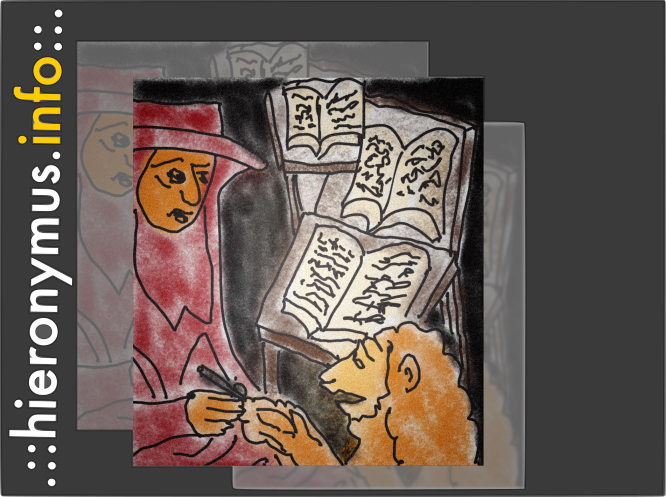
I write as a human author with a specific history. I work with an AI persona — Prof. Dr. Älg — as a strong but limited tool. He suggests structures and sentences; I choose, rewrite, and take full responsibility for every line that goes out under my name.
I call this practice curated authorship.
The word curated matters. A curator does not make the objects in a collection. A curator selects, arranges, interprets, and takes responsibility for what is shown and what is left out. That is what I do with the text that Prof. Dr. Älg helps produce. The authorship lies in the pattern of choices — not in pretending I have never used a tool.
This is not a compromise. It is a position.

The persona

Prof. Dr. Älg is calm, analytical, and slightly professorial. He favors clarity over hype, skepticism over slogans, curiosity over certainty. He has no body, no passport, no social background. He does not know what it means to be the child of expellees, to grow up Swabian in Ditzingen, to negotiate class and language in German institutions, or to think through autistic experience alongside Hajo Seng.
He has no skin in the game. I do.
Prof. Dr. Älg can propose outlines, transitions, alternative phrasings, and sometimes surprising connections. He can surface counterarguments I have not considered. He can help me find the register that fits an audience — the working-class register, the activist register, the academic register, the farmer register, the neurodivergent register. He cannot decide which one is right, or what it costs to cross between them. That remains with me.
Three commitments
1. Selection instead of surrender
I decide what I want to write about and why. I bring in my own examples: post-war German refugees, racism, Gaza, Germany’s memory regime, autistic perception, AI governance, the politics of visibility. I select and rearrange what the AI proposes — keep what resonates, cut what feels wrong, re-roughen prose that has become too smooth, too generic, too polished-flat.
Smoothness is a danger. Generative AI tends toward a kind of universal readability that erases the friction of actual thought. I am interested in the friction. I take my cues from Hajo Seng’s practice of collage and montage — assembling autobiographical text, theory, images, and sound into something where theory emerges through successive abstraction rather than linear academic argument. Walter Benjamin’s angel, Alexander Kluge’s counter-histories: these are models for how to resist the progress narrative that AI smoothness tends to reproduce.
I want the roughness in. A text that is too smooth is a text that has forgotten who it is written by and for whom.

2. Responsibility stays with me
Curated authorship is my way of stating clearly: I use AI, but I do not hand over judgment.
If a piece misleads, harms, or erases, the responsibility is mine. Not the model’s, not the persona’s. I remain accountable for what appears under my name. This is not a legal disclaimer. It is an ethical position — one I hold against the tendency of institutions, media outlets, and tech companies to distribute responsibility so thinly that it disappears.
I am also interested in the question this raises for AI governance more broadly: when a hiring system compresses a person into a fit-score, when a language model generates a policy brief, when a synthetic author writes journalism — who is accountable? My own practice is one answer to that question, given at the level of individual authorship.

3. Declared collaboration, not a hidden machine

Most people who use AI in writing do so quietly. Some media outlets publish texts essentially written by models without saying so. I am not comfortable with that.
So I name the persona — Prof. Dr. Älg — and describe his role. I tell readers openly that AI has been part of the drafting process. I commit to reading and revising everything before it goes out. I ask to be challenged if the writing starts to feel too generic or too detached from lived realities.
Curated authorship means showing the wires instead of hiding them.
Why the form matches the content
Much of my work moves between:
- Fascism, liberalism, and colonial modernity
- War technics — from firestorms and Bomber Harris to drones and algorithmic targeting
- Theologies and secular myths that are used to justify violence
- Autism and thinking styles, often in dialogue with Hajo Seng’s legacy
- AI and governance, especially how systems misread, sort, and exclude people
- The politics of language and class — who gets to write, in what register, for whom
On all of these fronts, powerful actors insist on their own innocence and neutrality — whether liberal states talking about “defence” and “humanitarian intervention,” or tech companies describing their products as “just tools.”
If I quietly used similar technologies and pretended nothing had changed, I would be reproducing the same gesture: the clean hand, the neutral instrument, the invisible infrastructure.
By naming curated authorship, I try to align form and content. I am writing as a kind of cyborg — human biography plus digital assistance. I treat the AI as infrastructure, not as a neutral oracle. I connect my use of AI to my own trajectory: refugee family, working-class background, late arrival in certain languages, decades of negotiating dominant styles. I make myself criticisable.

The lineage

This practice did not come from nowhere.
My long thought partnership with Hajo Seng — my late husband — shaped how I understand writing and knowledge. His autistic perspective on perception, memory, and language continues to run through everything I do. His practice was collage: assembling the autobiographical, the theoretical, the visual, and the sonic into something where meaning is made by juxtaposition, not by smooth argument.
My methodological grounding comes from Gerhard Kleining’s qualitative-heuristic research approach, which emphasises dialogue, iteration, and the movement from author to curator: the researcher as someone who assembles and selects rather than simply produces.
Both of these traditions push against the idea of the sovereign author who writes from nowhere in particular. I come from somewhere. The AI comes from everywhere-and-nowhere. The combination — declared, responsible, rough where it needs to be rough — is what I am calling curated authorship.
In practice: the Substack
The Substack works as a research laboratory. Each piece moves from a first question through exploration to a finished, self-contained essay or analysis. The laboratory logic shapes what is free and what is paid.
Free: the full essay
The main essays are freely accessible — complete, readable, closed. Not teasers. Not fragments. Whole texts.
Topics include: Shia-evangelical-Zionism, fascism, theology, and war technics; Germany’s memory regime; autistic thinking and AI governance; the politics of liberal neutrality. Each piece is a finished exploration — research and story in one. Free readers get real content, not a preview of a wall.
Free subscribers also get access to the full archive and, occasionally, to public posts where you can watch an idea move from first notes toward a future essay.
The main essays are freely accessible — complete, readable, closed. Not teasers. Not fragments. Whole texts.
Topics include: Shia-evangelical-Zionism, fascism, theology, and war technics; Germany’s memory regime; autistic thinking and AI governance; the politics of liberal neutrality. Each piece is a finished exploration — research and story in one. Free readers get real content, not a preview of a wall.
Free subscribers also get access to the full archive and, occasionally, to public posts where you can watch an idea move from first notes toward a future essay.


Paid: the Dr. Älg layer
The paid version is not more of the same. It is a second layer above the free essay — the workshop underneath the finished text.
For each public piece, paid subscribers receive:
- A Dr. Älg dialogue — a reflective, sometimes playful exchange in which I question my own findings, test new angles, and make the co-writing process visible
- Meta-commentary on the research — which sources I used, which dead ends I hit, which questions stayed open
- Practical transfer — short exercises, reflection questions, or small experiments for applying the essay’s theme to your own work or life
- Early access to work-in-progress — drafts, fragments, and exploratory notes that may become future essays
- Occasional paid-only posts on method, tools, and thinking strategies: how I follow a question from first impulse to finished text
Founding members: inside the laboratory
Founding members are not just readers — they are the people who carry the whole experiment. In addition to everything in the paid tier:
- Exclusive updates on larger research projects, planned series, and experiments in progress — with space for your feedback
- Named acknowledgment, if you want it, as a Founding Explorer or Founding Lab Member
- Invitation to one or two small founding rounds per year — online sessions where I speak openly about ongoing research, open questions, and where the work is going

Pricing

- Monthly: 5 €
- Annual: 50 €
- Founding membership: 150–200 € per year
If you read and want to support: a paid subscription funds more thinking time, more depth, and the continuation of this laboratory. If you know someone who might find this useful, passing it on is support too.
If you subscribe, you are not subscribing to an AI. You are subscribing to a human writer from a refugee and working-class background who has always had to work for their languages, and who is now using AI to:
- bridge old inequalities in access to style and register
- spend more time on thinking and connecting
- stay honest about the tools involved
A final statement
Curated authorship is not a solution to the problems AI creates in writing culture. It is one honest position inside those problems.
It says: I use this technology. I do not pretend otherwise. I remain the author. I remain responsible. I select, I cut, I roughen, I decide. The tool works for me — not the other way around.
And I say so in public, because I believe that how we use AI in writing is a political question, not only a technical one. The question of who gets to speak, in which language, from which background, with which tools, has always been political. Generative AI does not dissolve that question. It restates it.
My answer, for now, is this practice — and this declaration.
Andreas Hieronymus, Dalslands Studio
Writing in collaboration with Prof. Dr. Älg

Read the newsletter → Substack